

Does Organizational Culture Really Matter in 2026? Here's the Truth
- saafir.jenkins

- Jan 15
- 5 min read
Let's cut to the chase: organizational culture isn't just a "nice to have" in 2026: it's a strategic imperative that directly impacts your bottom line. Yet a dangerous gap exists between what leaders say they believe and what actually happens on the ground. While 77% of C-suite executives claim culture is "very important," only 37% of entry-level employees share that sentiment.
That disconnect? It's costing you talent, productivity, and competitive advantage every single day.
This article breaks down why culture matters more than ever in 2026, what's changed in the past few years, and: most importantly: the concrete steps you can take to transform culture from an abstract concept into a tangible business driver.
The Culture-Performance Connection: Why This Hits Your P&L
Stop thinking of culture as something HR handles while the "real business" happens elsewhere. Companies that intentionally build culture around connection, purpose, and trust consistently outperform those treating it as an afterthought.
Here's what culture directly influences:
Retention rates – Employees stay 2 years longer when their organization provides both high expectations and high support
Innovation capacity – Teams that feel psychologically safe take calculated risks and propose new ideas
Collaboration quality – How well your cross-functional teams work together determines speed to market
Leadership credibility – Your ability to drive change depends on the trust you've built
The math is straightforward. When engaged employees reinforce culture, and strong culture strengthens engagement, you create a virtuous cycle that boosts productivity, loyalty, and retention simultaneously. When culture breaks down, so does everything else.

The 2026 Reality: Why Old Playbooks Don't Work Anymore
If you're still relying on pre-2020 culture strategies, you're operating with outdated equipment. The nature of workplace culture has fundamentally shifted, and leaders who haven't adapted are watching their best people walk out the door.
Hybrid Work Changed Everything
Culture can no longer rely on office routines and physical proximity. The casual conversations by the coffee machine, the spontaneous brainstorming sessions, the visible energy of a busy office: these cultural reinforcement mechanisms have either disappeared or dramatically diminished.
Make culture tangible for employees through visible recognition, real flexibility, and values practiced daily. Abstract mission statements mean nothing when your team is scattered across time zones and home offices.
The Transparency Imperative
Employees in 2026 expect transparency across four critical dimensions:
Personal work – Clear expectations, honest feedback, visible career paths
Community connections – Understanding how their role fits into the bigger picture
Decision-making – Knowing why choices are made, not just what was decided
Accountability – Seeing that standards apply equally at every level
Organizations that master transparency build trust. Those that don't? They breed cynicism and quiet quitting.
The hidden cost of cultural disconnect is staggering. Learn more about how strategic people alignment saves companies millions annually.
The Perception Gap: Your Biggest Cultural Blind Spot
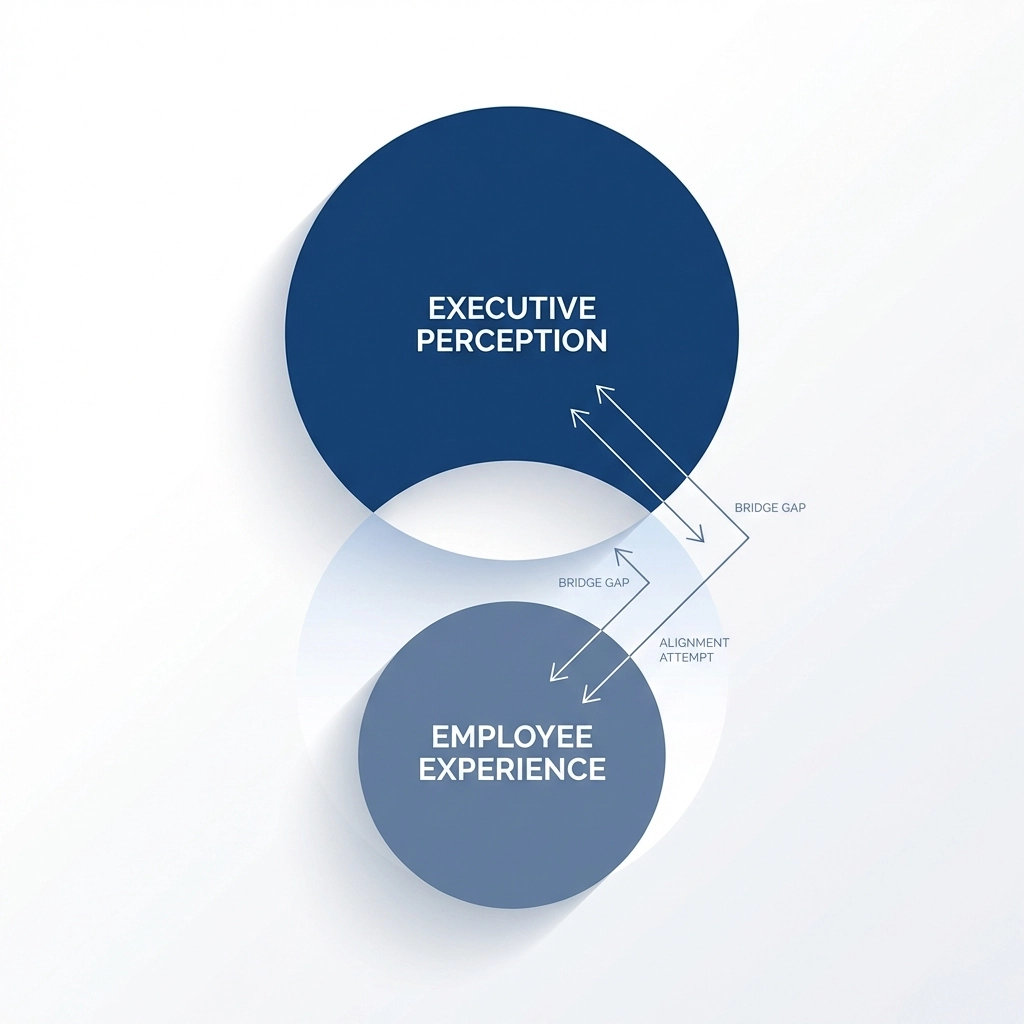
Here's an uncomfortable truth: there's likely a massive gap between how your leadership team perceives your culture and how your frontline employees experience it.
That 40-point gap between C-suite and entry-level cultural perception isn't just a survey anomaly: it represents a fundamental breakdown in organizational alignment. When leaders assume culture is strong while employees feel disconnected, every strategic initiative becomes harder to execute.
Why This Gap Exists
Leaders experience culture differently. They have more autonomy, more access to information, more influence over their daily experience. The friction points that frustrate frontline employees often remain invisible at the executive level.
Communication flows downhill but rarely climbs back up. Values get announced from the top, but feedback about whether those values translate into daily reality rarely makes it back to decision-makers.
Symbolic gestures replace systematic change. Pizza parties and wellness webinars don't fix broken processes, unclear expectations, or managers who don't embody stated values.
Building Culture That Actually Works: A Strategic Framework
Stop treating culture as a standalone initiative. Embed cultural principles into everyday work processes, performance reviews, and decision-making structures. Here's how to make that happen:
Step 1: Audit Your Current State
Before you can improve culture, understand where you actually stand: not where you think you stand.
Conduct skip-level conversations where senior leaders talk directly with frontline employees
Analyze exit interview data for patterns in why people really leave
Review your performance management process for alignment with stated values
Assess manager behavior against cultural expectations
For practical approaches to modernizing your performance processes, explore these culture-building hacks that replace outdated reviews.
Step 2: Focus on Team Dynamics, Not Just Leadership
Here's a finding that should reshape your cultural strategy: conversations with coworkers are the top source of inspiration for employees, with 68% having at least one coworker who inspires them.
This means culture isn't just a top-down phenomenon. Peer relationships, team norms, and local micro-cultures matter as much: sometimes more: than executive messaging.
Action items:
Invest in team-level interventions, not just company-wide programs
Train managers to facilitate healthy team dynamics, not just manage tasks
Create opportunities for peer recognition and cross-functional connection
Address toxic team members quickly: one bad actor can destroy local culture

Step 3: Practice Authentic Leadership
Top-down management approaches are dying. What's replacing them? Authentic leadership that communicates openly and listens actively.
Authentic leadership looks like:
Admitting when you don't have answers
Explaining the reasoning behind difficult decisions
Soliciting input before finalizing strategies
Following through on commitments consistently
Holding yourself to the same standards you expect from others
Step 4: Build Feedback Loops Into Everything
Organizations that treat culture as a responsive system: one that incorporates feedback and employee input continuously: emerge as strategic leaders. Those that treat culture as a static "thing" they defined once fall behind.
Implement these feedback mechanisms:
Pulse surveys (monthly, not annual) to track cultural health
Manager check-ins that explicitly discuss team culture
Open forums where employees can raise concerns without fear
Action reporting that shows what changed based on feedback
When employees see their input leads to real change, engagement increases. When feedback disappears into a void, cynicism grows.
Understanding the connection between operational excellence and employee experience is critical. Dive deeper into balancing operational excellence with employee well-being.
The Bottom Line: Culture Is Strategy
In 2026, the organizations that thrive share a common characteristic: they treat culture as a core strategic capability, not a supporting function. They invest in culture with the same rigor they apply to financial planning, product development, and market expansion.
The question isn't whether organizational culture matters. The question is whether you're willing to do the systematic work required to build culture intentionally.
Here's what that work looks like:
Close the perception gap between leadership and frontline employees
Embed cultural principles into daily operations, not just posters on walls
Invest in team dynamics alongside leadership development
Build continuous feedback loops that enable rapid cultural adaptation
Hold everyone accountable: including executives: to cultural standards
The organizations that master these capabilities will attract top talent, retain their best people, and execute strategies faster than competitors who treat culture as an afterthought.
Ready to Transform Your Culture Into a Competitive Advantage?
Optimum Human Centered Solutions helps organizations close the gap between cultural aspiration and daily reality. Contact us to schedule a consultation and discover how our human-centered approach can strengthen your culture while driving measurable business results.
Comments