

The Ultimate Guide to Skills-Based Talent Development: Turn Role Ambiguity Into Competitive Advantage in 2026
- saafir.jenkins

- Feb 9
- 7 min read
Traditional job descriptions are dying: and fast. The career framework that defined workforce planning for the past 50 years is collapsing under the weight of technological acceleration, market volatility, and the AI transformation reshaping every industry. When roles evolve faster than HR can rewrite position descriptions, organizations face a critical choice: cling to outdated role-based structures and watch talent mobility grind to a halt, or embrace skills-based talent development and turn ambiguity into your most powerful competitive advantage.
The data tells a compelling story. Seventy percent of employers now use skills-based hiring, up from 65% just one year ago. By 2025, 85% of organizations will adopt skills-first approaches. This isn't a trend: it's a fundamental restructuring of how high-performing organizations identify, develop, and deploy human capital.
Here's the strategic imperative: skills-based talent development shifts organizational focus from rigid job titles and fixed roles to demonstrated capabilities and transferable expertise. This approach enables you to respond dynamically to market disruption and redeploy talent with unprecedented flexibility. For business leaders facing constant transformation, this framework doesn't just improve HR efficiency: it directly impacts your ability to execute strategy at speed.
Why Traditional Role-Based Structures Are Failing Your Organization
Role-based talent management operates on a flawed assumption: that work can be neatly packaged into static job descriptions with predictable career ladders. This model worked reasonably well in stable markets with slow technological change. It fails catastrophically in 2026.
Consider the practical reality. Your competitors launch new AI-powered products overnight. Regulatory frameworks shift quarterly. Customer expectations evolve faster than product cycles. Yet your talent infrastructure still relies on annual performance reviews tied to position descriptions written three years ago.
The disconnect creates three critical business risks:
Reduced organizational agility. When business demands shift, role-based structures force you into lengthy recruitment cycles or expensive external hiring. You lack visibility into existing capabilities across your workforce, preventing rapid talent redeployment.
Constrained talent pools. Traditional hiring based on credentials and linear career progression excludes qualified candidates from non-traditional backgrounds. You're competing for the same overqualified talent as everyone else while overlooking high-potential professionals who could deliver immediate value.
Erosion of competitive positioning. Organizations that can identify skills gaps, build capabilities strategically, and mobilize talent dynamically simply move faster. They respond to opportunities while you're still defining the job description.

Converting Role Ambiguity Into Strategic Advantage
Skills-based organizations don't eliminate roles: they fundamentally reimagine how talent connects to business outcomes. Rather than operating with fixed job descriptions and linear career paths, you create dynamic environments where employees are matched to projects and opportunities based on demonstrated abilities.
This approach delivers measurable competitive advantages:
Accelerated Response to Market Disruption
Market shifts now happen overnight. Organizations with comprehensive skills visibility can flexibly deploy talent to address emerging threats or capitalize on opportunities infinitely faster than competitors trapped in rigid role structures.
When you know exactly what skills exist across your workforce: including latent and adjacent capabilities: you gain a strategic asset for workforce planning. This visibility enables scenario planning: if we pivot to this market, do we have the skills internally? If we lose these three senior leaders, which employees have adjacent capabilities to step up?
Expanded Access to Critical Talent
Skills-first hiring shifts focus from credentials to capability. By prioritizing demonstrated ability, applied learning, and real-world outcomes, you identify professionals who may not follow conventional career routes but can still deliver exceptional value.
This expands your talent pool significantly. You're no longer competing exclusively for candidates with specific degrees from target schools or linear career progressions. You're accessing diverse talent with transferable skills from adjacent industries, non-traditional backgrounds, and underrepresented groups.
Enhanced Innovation and Collaboration
When employees are deployed based on skills rather than titles, cross-functional collaboration increases naturally. Your best analytical thinkers work on data challenges regardless of their organizational home. Your strongest communicators shape critical client presentations even if "communications" isn't in their job description.
This fluid talent deployment breaks down silos, accelerates knowledge transfer, and drives innovation through unexpected combinations of expertise.

Your Implementation Roadmap: Five Phases to Skills-Based Excellence
Moving from theory to practice requires systematic execution. At Optimum Human Centered Solutions, we guide organizations through a structured transformation that aligns skills-based approaches with core business outcomes.
Phase 1: Establish Your Skills Foundation
Begin with comprehensive skills gap analysis that goes beyond surface-level inventories:
Inventory existing capabilities across technical, human, and leadership domains. Include latent skills employees possess but rarely use in current roles, plus adjacent skills that could add future value with minimal development.
Map skills directly to business strategy. Identify which capabilities align with long-term goals and competitive positioning. This isn't an HR exercise: it requires partnership with business leaders to understand strategic imperatives over the next 2-5 years.
Prioritize gaps with strategic impact. Focus on skills critical for execution: AI literacy, digital fluency, cross-functional collaboration, emotional intelligence, and emerging technical capabilities specific to your industry.
Establish baseline metrics. You cannot improve what you don't measure. Define how you'll track skill development, deployment effectiveness, and business impact over time.
Phase 2: Build Dynamic Skills Infrastructure
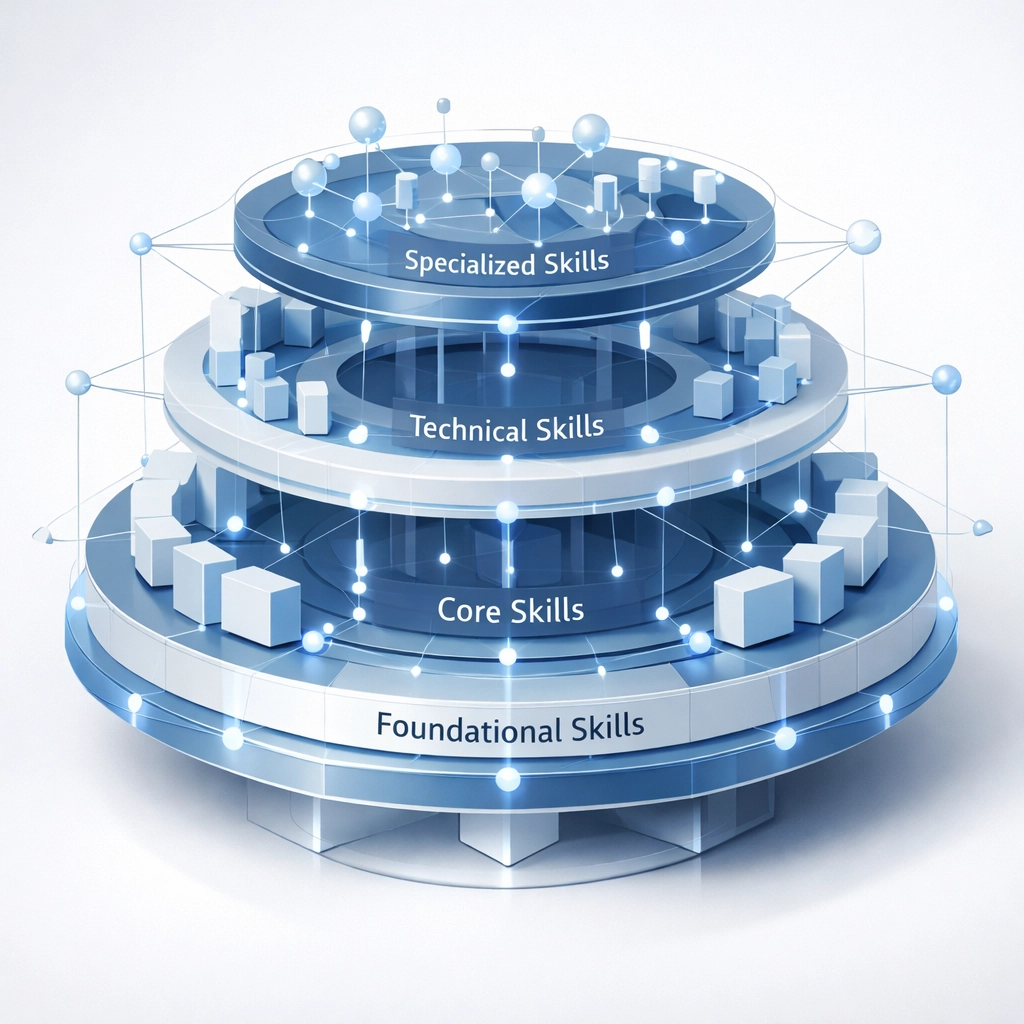
Develop a skills taxonomy: a structured catalog of competencies grouped and categorized to reflect relationships, skill levels, and career pathways. Unlike static lists, effective taxonomies evolve as business conditions change.
Current organizational data shows momentum: 38% of organizations now maintain a single, enterprise-wide skills library (up from 30% in 2023), and 55% map skills directly to jobs (up from 47% in 2023). These numbers reveal both opportunity and competitive gaps.
Select technology platforms supporting:
Skills assessments and mapping to capture competencies and identify gaps
Internal talent marketplaces enabling employees to find opportunities aligned with their capabilities
Learning management systems supporting continuous upskilling and reskilling
Analytics delivering insights on skills data, trends, and alignment to business objectives
Your infrastructure must support skills visibility, not just skills tracking. Leaders need real-time access to workforce capabilities for strategic decision-making.
Phase 3: Activate Personalized Learning Pathways
Create clear roadmaps showing how employees develop from current skill levels to desired capabilities. Effective learning pathways include recommended resources, suggested experiences, potential mentors, and realistic development timeframes.
Critical distinction: Learning pathways differ from traditional career ladders because they focus on capability building rather than position climbing. An employee might develop advanced skills while remaining in their current role, then leverage those capabilities for lateral moves, special projects, or leadership opportunities.
This approach addresses the retention crisis facing high performers. Rather than losing talented employees because they see no upward mobility in rigid hierarchies, you offer personalized growth opportunities tailored to individual strengths and aspirations.
Phase 4: Embed Skills Into Your Talent Lifecycle
Skills-based thinking must integrate across every talent touchpoint:
Talent acquisition and onboarding: Hire for skills and cultural fit, not just role requirements. Onboarding should immediately identify additional capabilities new hires bring beyond their job description.
Performance evaluation: Assess skill development and application, not just task completion. Link performance to capability building and business outcomes.
Internal mobility: Make skills data accessible so employees can identify opportunities aligned with their capabilities. Reduce friction in internal movement.
Succession planning: Identify future leaders based on demonstrated skills and growth trajectories, not tenure or current position.
This embedding ensures skills-based approaches drive decisions rather than existing as parallel HR initiatives disconnected from business execution.
Phase 5: Pilot, Measure, and Scale Strategically
Start with a single business unit or strategic project to demonstrate quick wins before enterprise-wide rollout. Pilot programs allow you to refine approaches, build leadership champions, and generate proof points that accelerate broader adoption.
Track meaningful outcomes:
Increased employee engagement scores
Higher promotion and internal mobility rates
Improved retention, particularly of high performers
Enhanced workforce agility measured by speed of talent redeployment
Greater flexibility responding to market demands
Establish ROI metrics early. Use them to guide decisions, demonstrate value to stakeholders, refine strategies, and build the business case for scaling.
Developing Critical Skills at Scale
Skills-based infrastructure means nothing without intentional capability development. Prioritize capabilities most relevant in 2026's business environment:
Analytical thinking and innovation: The ability to interpret complex data, identify patterns, and generate creative solutions remains uniquely human even as AI handles routine analysis.
Critical thinking: Evaluating information quality, challenging assumptions, and making sound decisions under ambiguity cannot be automated.
Emotional intelligence and empathy: As human-AI collaboration increases, interpersonal skills differentiate high performers. Understanding stakeholder needs, navigating organizational dynamics, and building relationships drive outcomes.
Communication: Translating complex ideas for diverse audiences, facilitating collaboration, and influencing without authority become more critical as organizational structures flatten.
Adaptability and resilience: The capacity to learn continuously, pivot when conditions change, and maintain effectiveness through disruption defines workforce readiness.
Foster a growth mindset culture that encourages lifelong learning, skills development, and adaptability. This cultural shift is essential: 2026 demands ongoing upskilling as roles evolve, not static skill sets acquired once and deployed indefinitely.

Measuring Success: Beyond Vanity Metrics to Business Impact
Skills-based transformation must demonstrate tangible business value. Move beyond counting training hours completed or skills added to profiles. Instead, measure outcomes that matter to organizational performance:
Talent deployment velocity: How quickly can you mobilize the right capabilities to address emerging priorities? Track time from opportunity identification to skilled team assembled and executing.
Internal fill rates: What percentage of critical roles are filled internally versus external hiring? Higher internal mobility reduces recruitment costs and accelerates time-to-productivity.
Skills utilization rates: Are employees applying their full capability sets or operating below their potential? Underutilized skills represent wasted investment and frustration risk.
Business outcome correlation: Can you draw direct lines between specific skills development initiatives and measurable business results? Revenue growth, cost reduction, customer satisfaction improvements, innovation metrics: connect skills investments to outcomes executives care about.
Use skills data not just for reporting but for strategic planning. Workforce capabilities should inform market entry decisions, product development priorities, and competitive positioning.
Strategic Imperatives: Leading the Skills-Based Transformation
For talent development leaders, skills-based approaches are no longer optional: they're strategic imperatives for organizational survival. To prepare your organization:
Embed skills thinking into business strategy as a core pillar of workforce planning, not an HR afterthought. Skills capabilities should inform strategic planning at the highest levels.
Invest in talent development infrastructure including comprehensive skills taxonomies, valid assessment tools, integrated learning platforms, and friction-free internal mobility systems.
Assign clear accountability. Successful transformations require dedicated leadership: consider establishing a global head of learning and development with authority to oversee enterprise-wide change.
Monitor and measure continuously. Use skills data to refine strategies in real-time rather than waiting for annual reviews. Build feedback loops that accelerate learning.
Align talent strategies across the complete employee life cycle from acquisition through succession planning. Fragmented approaches undermine the systemic benefits of skills-based frameworks.
The organizations that fail to adapt to skills-based approaches risk becoming progressively less competitive. Those that ground themselves in continuous learning, agile talent deployment, and data-driven workforce planning can future-proof their workforce and unlock new levels of organizational performance.
At Optimum Human Centered Solutions, we specialize in aligning skills-based talent strategies with core business outcomes. We don't just help you build skills taxonomies: we partner with you to transform how your organization identifies, develops, and deploys human capital to drive competitive advantage.
Ready to convert role ambiguity into your strategic advantage?Connect with our team to discuss how skills-based talent development can accelerate your business objectives in 2026 and beyond.
Comments